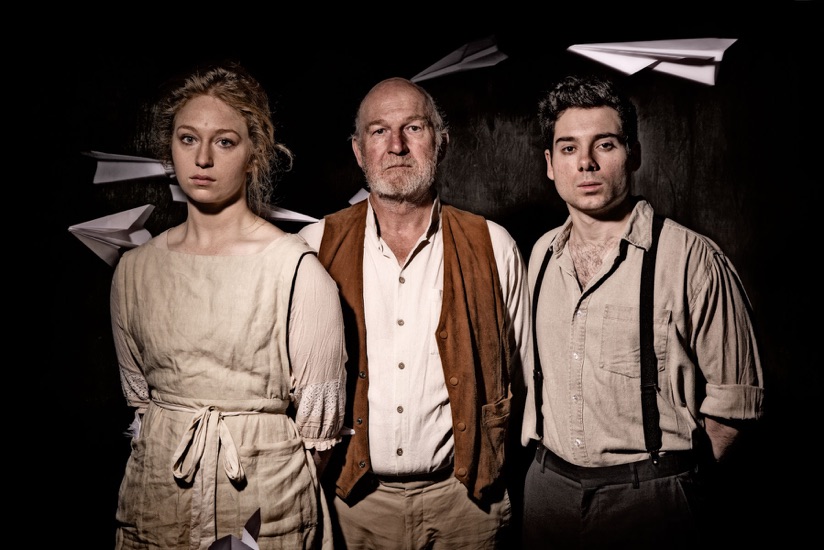
Last Monday night – 6th June - 7-ON gave a (sort of a) keynote speech for the recent Playwrights’ Muster held at Griffin Theatre in Nimrod Street. Vanessa and Verity officiated and Hilary rang some invaluable bells (hijacked from Vanessa’s four year old son’s stash, in fact. Thank you, Tristan!). We promised we’d make (most of!) the text available on the blogsite for anyone who might be interested to check it out. So…here it is!
…7-ON has been asked to give a bit of a run down on the past year of playwriting in Australia.
We thought we’d do it via the 7 Deadly Playwriting sins. Obviously not all of 7ON are here and probably that’s quite lucky because we can get a bit rowdy and also seven writers means seven different opinions and that’s 49 takes on the 7 deadly sins and that’s a long night.
We all took a sin. We all wrote something in response.
We don’t pretend to know the answer to the questions that came up over the year. Instead, we invite you to reflect on these and chat further wherever you see fit.
SIN THE FIRST: GLUTTONY
That’s it. The food thing – all the chocs you eat while you write – addictions to the little canapés at opening nights, free asparagus on toast, baby meringues – or, or….any time any of us may possibly have over-indulged in a substance that may have led to a degree of dis-inhibition … … exuberance, for example… at any or indeed every… Playwriting Australia Conference? Or - indeed - Facebooking while drunk. All valid examples of playwrights and gluttonous behaviour. Here’s what the first 7ON sinner had to say:
“Gluttony is an interesting proposition for a playwright in Australia, since we are the lowest paid of all the performance writers. Write 15 minutes of children’s TV, you get $4,000: write 15 minutes for the stage you might get a well-scrounged $500. But more likely you’ll get a couple of comps and a carrot stick dipped in hummus. So the idea of a playwright having the money to gorge on anything is…quaint. Figuratively, of course, gorging on self doubt or paranoia or isolation are obvious sins. But in a lot of the debates that have raged this year, I’m sadly aware of a systemic sin – ‘midcareer’ comrades who feel chewed up and spat out and deemed no longer edible.
Meaning, in some real sense, our theatre community seems to have had its fill of writers who are quite probably in their prime. Why? Faddishmess? Lack of imagination? Perceived conservatism and aesthetic dullness of anyone over 35? The impossibility of being the Next Big Thing twice? Who knows? I mean when Caryl Churchill writes something new, the world rejoices. She’s 73.
Is there a Churchill among us? We may never know. Playwrights decades younger than Churchill…are walking away- into the grateful arms of TV, poetry and academia. Why? To keep their joy. To not let it be devoured and spat out by the gluttonous beast of prevailing appetites and tastes. We sacrifice a lot to do what we do, but we must never sacrifice our joy. Which might mean knowing when to take your talent and training and expertise and insight elsewhere.”
So. Question: How many Australian playwrights are now finding their joy elsewhere?
SIN THE SECOND: SLOTH
Wikipedia defines SLOTH thus: Spiritual or emotional apathy, neglecting what God has spoken, and being physically and emotionally inactive
…through inactivity, one invites the desire to sin. "For Satan finds some mischief still for idle hands to do." Blah blah blah…There was a whole lot more of this sort of thing but frankly we couldn’t be bothered cutting and pasting anymore. Here’s our second sinner:
Sloth may seem an obvious playwright’s sin. Plop on your ug boots, ignore your emails, heat up yesterday’s coffee in the microwave, read the papers or go to the daytime movies for “research”. Loll about in front of the computer and write some shit but first you might see what’s happening on facebook or twitter. Read someone’s blog. Have sex. With someone else. Or yourself. Or just think about it for a bit and then go and eat some chocolate.
No need for makeup, for gym membership, let’s face it - barely any need for clothes really.
And apart from the writing bit which as we all know is incredibly relaxing and really really easy, there’s the what… phone calls to theatre companies? Emails to literary managers? Smoke signals to agents?Feeble attempts to set up meetings with artistic directors?
Half baked grant applications?
There’s a fair bit of postage involved yes, unsolicited scripts, competitions, so that’ll involve a walk or drive, a monetary transaction, shoving things into slots and of course there’s Officeworks, great lollyshop of a timesuck, biro-porn, sloth haven that it is. Hum de dum de dum…
Recently Australian quarantine were made aware of two animals being smuggled into Brisbane from Singapore, two small furry animals, terrified, clinging to each other, staring out with wide eyes and wondering what happened to their Southeast Asian jungle.
They were Slow Lorises. Not a sloth as such, the Slow Loris is smaller, cuter and seemingly has a far more miserable life. They’re highly sought after as pets thanks to youtube and their general cuteness. To make them pettable, they have their teeth cut off with nail clippers. Maybe 2% survive this. Not surprisingly, they’re endangered. And the two found on the flight to Brisbane were put down because there was no documentation to say that they were perfectly healthy in the first place.
.
So maybe it’s better to be a sloth after all. Or even a playwright. Unlike the Slow Loris we don’t have our teeth cut off and we’re rarely smuggled in tubes on international flights. But we are cute. And sometimes slow – to get active, to get angry, to get moving.And we don’t mean to be slothful, in fact there’s only two situations where I become a sloth. One is when I’m writing – because nothing else matters. And two is when I’m depressed. Because then I feel like nothing else matters at all.
But if you want to fight the sloth fight, remember it’s not just playwrights who are guilty of ignoring their emails…
QUESTION: Are playwrights the Endangered Species of Australian literature?
SIN THE THIRD: WRATH
There’s been a fair few angry moments in the last 12 months, haven’t there? A number of questions raised in our 7-ON email-go-round anyway. Among other places.
Of course, playwrights are generally not known as being… wrathful. We’re actually quite gentle creatures. This last year however, as a species, we went birko, ballistic, postal, spakka, off our nut. We got the pip, the shits, the red rage. We were quietly indignant,
ferociously vehement, deeply hurt, and really really pissed off.
And these were some of the questions being asked:
1. Where are the women playwrights?
2. Why was there an attitude that Australian plays were not worthy of being awarded the Ministry prize in 2010?
3. Why are the main companies doing more adaptations than new plays?
4. Where are the women playwrights?
5. Is this the era of the director not the playwright, and should we all just suck it up?
6. Are we (i.e. theatre generally) losing our audience or are they (the audience) evolving?
7. Is the writer as personality/celebrity becoming at least as important as the actual play they write?
8. Where are the women playwrights?
Here’s our third sinner’s response:
The Blank Screen by…one of us.
Subjects for poems:
Avoid the royal family like the plague, same for yucky disease, but rats have possibilities, even fleas. Cats have been done by T.S Eliot. Death is reliable. Love works best when it’s lost or unrequited. Be careful with melancholy, no one likes a whinger. 'I wandered lonely as a cloud' blah, blah, blah. Age has stood the test of time. Old photos, old people, old vases. Ditto nature: autumn, tulips, the rain in Ireland. Keep found text for emergencies. Don’t try to be funny. Comedy belongs on the stage.
Subjects for plays:
Men and war. Love and murder – ideally seta against a backdrop of war. The zeitgeist in local accents. Snapshots of here and now. Juxtaposition is OK, allegory is not - unless you’re Arthur Miller. Leave poetry to Shakespeare. Important men, men at war with themselves, men with their feet on the ladder going up. A culture is remembered for the splash of its art not the durability of its sewer system. History is borderline, but war is guaranteed. No matter the drama, characters should be 34 years old.
QUESTION: What if I never get a play up again? What if that was the last production I’ll have? What if I never get a first production? What if that was my first and last production? What if?
SIN THE FOURTH: ENVY
A letter from…one of us…
I know all about playwright-envy. A few years ago I was living far away and had two babies, no family, no money, so my theatre-going activities were confined to reading reviews, often of my peers' plays. My resentment of their getting productions was only alleviated by the schadenfreude of bad notices.
When the opportunity arose to form an alliance with six other playwrights, I saw it as a chance to air grievances and rejoice in their success. And that, for me, was the impetus behind founding 7-On.
I still take the name of the Lord in vain when I get a rejection letter, I still covet other people's awards, but being part of this playwrights' company has helped me to sin less. Salvation has lain in sharing both the triumphs and the humiliations of my colleagues. Generosity is an integral part of creativity, and envy is paralysing. I'm hoping by our next forum, we will be able to speak from experience about the Eleven Virtues.
QUESTION: When the pie is so small, how can our community ensure that everyone who deserves a piece gets one?
SIN THE FIFTH: LUST.
It would be ever so easy to get the wrong idea with our next sin, to be inappropriate or untoward, to speak disparagingly of actors, to be steamy and smutty and complain about dampness of the nether regions (due to rising sea levels) and finally insist the whole thing is, to quote Tony Abbott, “crap”. But in fact we’re not here to talk about climate change.
Instead, we move onto sin number 5 which is surprisingly brief. Perhaps because playwrights know what they want, what they really really want:
Here are what we thought were the top 7 lusts for a playwright
1. A director who has an ear for language and an eye for an elegant and hard-working design. And a great manner on the floor.
2. A producer who combines hard-nosed pragmatism with a passion for art.
3. A cast who will push for clarity in rehearsal and perform with generosity right through the season.
4. A critic who will review the play in terms of the task and style it sets itself instead of the one she/he would have preferred it to.
5. An audience that gives standing ovations every night. (We did say ‘lust’!)
6. Publication, enormous sales and not to be pulped
7. A box office that surrenders rivers of gold - or at least enough to pay the bills.
And stationery. Good stationery. We’ve mentioned one third of the Bermuda Triangle For Playwrights i.e. Officeworks, the other two being of course Smiggle and any shop stocking Moleskins. Even as we put this speech together, let the records show, one of our playwrights who shall remain nameless brandished their very new, very expensive, very lust-worthy pen.
It was a yellow fountain pen with black ink.
And it was lush.
QUESTION: What more could any playwright want?
SIN THE SIXTH:
It comes before a fall, it’s a U2 song, a parade, a bunch of lions, half a Jane Austen novel.
It’s number six, it’s PRIDE
Well, listen. Maybe some sins aren’t so sinnish at all. Maybe we can have a different take on Pride. Listen to this:
“Creativity is a life blood for people. We’re not talking life blood for artists – although of course it is that – we’re talking about communities, people”. Mike Leigh.
“Artists create a vocabulary for the future." Wesley Enoch.
‘The role of the artist I now understand as that of revealing - through world-surfaces - the implicit forms of the soul’ Judith Thurman.
This is a hard gig. I think one can be justifiably proud to take it on. We’re proud of our productions and publications, we’re proud of our camaraderie and the fact we’ve stuck it out this long, we’re proud to welcome such a talented bunch into this community and to watch them grow. Like Edward Albee said, we’re proud to swim – whatever the strokes we have made or will make - in the same river as Albee himself, as Shakespeare and Churchill and the Greeks.
QUESTION: Aren’t you?
SIN THE SEVENTH: GREED
Gordon Gecko famously said Greed is Good. He was actually talking about money and everyone knows that playwrights don’t do it for the money, they do it for the glamour.
This quote was from a movie in the eighties and we also know that the eighties was quite a reasonable sort of time for a working playwright.
It should also be pointed out that geckos in general are not endangered species.
At least they didn’t seem to be in Penang, in the eighties. Honest to god the little rascals would shit on everything and the noise they’d make when they were going for it…talk about lust….
But back to greed:
Here’s a rapid response to the sin of greed :
"I'm greedy for a revival of regional theatre companies because it's my firmly held belief that one of the reasons it is so hard to get our work done is the death by a thousand cuts of regional theatre companies like the Q (now a venue), the Hunter Valley Theatre Company, Theatre South, The Riverina Trucking Company, Mainstreet Theatre, Junction Theatre, Theatre ACT and the New England Theatre Company I could go on but whoever is reading this might run out of breath and faint and provide one of you with the turning point for a new play which will then compete with my new masterpiece which i haven't yet written but might if someone funds regional theatre again..."
QUESTION: Do you really want to hurt me? Do you really want to make me cry? (Boy George, circa 1982)
We want to end with a little extra. A bonus sin if you like. When we first started talking about tonight and what we might talk about in relation to the seven deadly sins, one of us wrote this:
“On Facebook tonight, someone asked. “Why do you Write?” Why do you write?
It reminded me of the time in my life when I did decide to give up on writing. I had basically just been told that I had missed out on a place in AFTRS after a long and horrible interview, following a long and intensive application. I was living in a caravan in Wollongong. It was cold and rainy and I was devastated by this latest rejection. I decided I needed to follow my father’s advice to “GET A REAL JOB”. Writing was too hard and too soul destroying and I wasn’t cut out for it.
Anyway I wandered Wollongong CBD crying to myself and I was freezing and I decided, spur of the moment to go into a cinema and see whatever film was on. And I realised at a time when I felt really low and about to give up, that actually I needed to see and to hear…a story. I was comforted by story and character because above all else I actually am a writer no matter what, if my writing is fashionable or not, if it is performed or not, if I am successful or not.
This realisation was strangely comforting. Because I realised… I have no choice.
I am a writer I must therefore write.
And it occurred to me tonight that the greatest sin of playwriting is not wrath or envy or lust or gluttony or sloth or pride or greed but despair. Giving up on your species. Giving up on the whole idea of Australian playwriting. Australian storytelling. . Not just individually as playwrights but collectively as an industry.
As playwrights we wrestle with all the sins all the time but this last one, the defeat of hope, the triumph of despair is probably the biggest of them all.
And it’s not just the writers who suffer from it, time and again we hear others in our tribe, the other theatre makers, indicate that basically they have given up. On us. For whatever reason they like to give, they make us believe that our stories are not worthy of being told.That’s not everyone, of course. But enough to make us feel gluttonous and angry and greedy and envious and lustful and slothful and proud.
It feels bad sometimes. Being a playwright. It feels fucking terrible sometimes. And every now and then it feels sublime. No matter what,we write. Because we have to. Because we’re writers.
So if you are a playwright, don’t give up. Fight for that joy, find the places where your voice will be heard, where your stories can be told. They’re there. Somewhere.
And if you’re everyone else, don’t give up on us.
No questions.
END