7-ON
Bit of a quiet time on the group front. We're still discussing out next joint project, what it might be and what form it might take. Meanwhile,
Sharp Darts is out there in bookshops, in libraries and online. Why not buy a copy and support Australian playwriting?
Photo by Dylan Nolte
HILARY
My theatre year kicked off with a joyful little production at the Australian Design Centre, as part of Sydney Festival and co-produced with Griffin Theatre. This was Window, Cricket Bat, performed by Lucia Mastrantone and directed by Jen Rani.
Next came a musical for young audiences, Alphabetical Sydney: All Aboard!, created by myself, Antonia Pesenti and Greta Gertler Gold. Produced by Critical Stages Touring, it opened at Riverside Theatres in April. Like shows all over, it had its Covid casualties (see earlier post) but despite setbacks, the dedication of all involved meant we had a musical for the hundreds of appreciative kindy kids who arrived with lunchboxes and legionnaires’ caps.
As I write this, Greta and I are in the studio, recording a CELEBRITY VARIETY ALBUM of the songs from the show. So far we’ve recorded Sydney legends Paul Capsis, Justine Clarke and Sheridan Harbridge, with a line-up of fabulous artistes to come.
Greta and I have also been busy with our Picnic at Hanging Rock musical. We have a couple of crackerjack songs and are charting a course for the show’s development over the coming year.
I’ve been hard at work on the Pavarotti musical (see earlier update), writing a new draft. And I’m gearing up for The Marrickville Mermaid, a song cycle written with composer Luke Styles, which has a showing as part of the Inner West’s Edge Festival in August at—and in!—the Annette Kellerman Pool. A few days later, I head to the UK where we’ll further develop the show as part of the UK/Australia Season, at Stapleford Granary.
Looking forward to teaching a weekend course at Writing NSW, that got bumped by Covid from one date to the next over the past year. I used to teach a lot and have missed it.
VERITY
I’ve been locked in a research task for much of the last six months—useless to talk about it as there’s an even money chance it will go nowhere. But fascinating! And all in my own South Australian backyard, which becomes more and more important as you age. From having rejected my own background as a younger woman I am finding I am bewitched by the landscape and stories of my home. When that landscape is as breathtaking as the South Australian regions, and the small city on its coast an idiosyncratic encapsulation of Australia’s troubled colonial history, that can be addictive. And perhaps I am looking backwards in part because trying to look forwards is so terrifying. (And because one should not write such a word without offering an antidote, can I quickly mention the work of Australian Buddhist nun, Jayasara for anyone who shares my fears).
Apart from that, I have had one workshop/reading of my adaptation of a contemporary Australian novel that is now scheduled for performance with the STCSA in the latter half of 2023. I have no doubt that the title may be the worst kept secret in Adelaide but I’m keeping mum until the company officially announces its season in September of this year. We have another three-day workshop coming up next week, about which I’m excited and nervous, as one inevitably is.
I’ve continued to work on the poetry collection scheduled for publication in the UK at some point when all stars align. Also published a poem in the Griffith Review #76: Acts of Reckoning, which is so worth a read quite apart from my offering.
And, together with yoga and chant teacher Sally Riddell I held a (most successful!) yoga / meditation / storytelling and writing retreat near Blinman in the mid-Flinders Ranges. We have another one planned in September. See Sally’s website for details. We are keeping numbers tight so if you’re interested sign up soon!
VANESSA
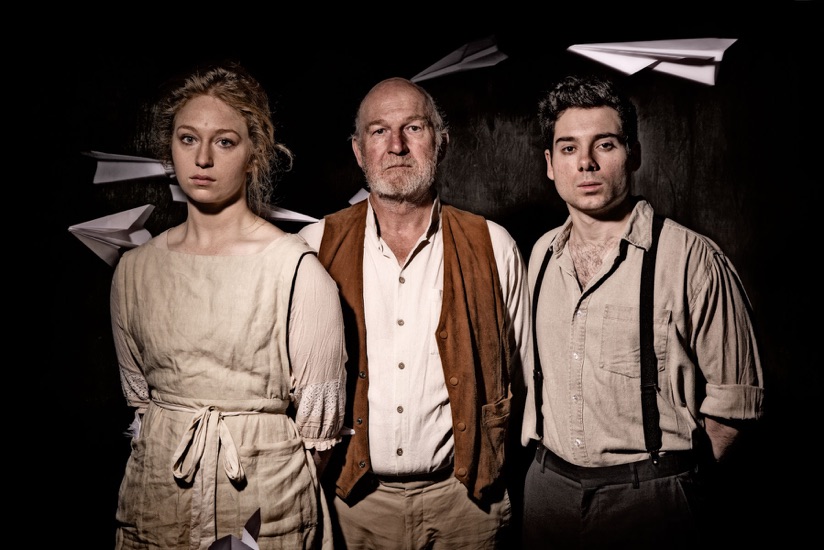
So I’m currently in rehearsal for my new play The One. What does this mean for a playwright? Well it’s a new play, a ‘world premiere’ as the leaflet for the play explains, and so, for starters, that means a lot of questions.
Because of course the developments have been a 2D process, everyone bent over my script, but now actors are UP and deep in the 3D process. There is walking and running and jumping and quite a lot of dancing and a LOT of questions. And cuts. And changes. And new lines born and old lines killed off no matter how funny we found them in the development. There is a classic quote in playwriting teaching where newbie playwrights are advised to ‘kill your babies’. This seems harsh and actually reflecting upon this term I think maybe it was a line I was made to shout when I played King Herod in a Christmas play I was involved in aged about 7 (it was the times) so maybe I wouldn’t use this particular advice in any playwriting workshop I teach now.
But I would say … expect the questions, and in fact welcome the questions. Everyone involved in production brings a unique take to the process, whether via their character, the overall flow of the piece, the costuming and design, the music, the choreography (I told you about the dancing) … everyone is suddenly viewing this world through their own lens and naturally questions arise. So … yes to the paper swan napkins, no to the Air Supply reference and can the tofu be served in a bowl?
And because I live in Newcastle and the play is being produced in Sydney (the Ensemble Theatre) when I can’t be in the room, I’m on the Zoom. (You can say that to yourself like a sort of jolly rhyme). And we sort through the questions and move through the script and the wheel turns. And where the wheel ends is anyone’s guess. But this part, the question part, the 2D into 3D part, is brilliant. It’s completely dance-worthy. And as our old friend Nietzsche is meant to have said: ‘We should consider every day lost on which we have not danced at least once.’
The One by Vanessa Bates, directed by Darren Yap. Ensemble Theatre 22 July to 27 August 2022
NOËLLE
The year began with Siren Theatre Company’s premier season of
The End of Winter at the Griffin. It was a joy to be collaborating again with the
Good With Maps team—director Kate Gaul, performer Jane Phegan and composer / sound designer Nate Edmundson. Despite the ever-present coronavirus we got good audiences, great responses, and our single actor did not catch Covid.
In that classic freelancer’s feast or famine, the week after The End of Winter opened, an audio work, Mrs C Private Detective, went to air on ABC RN’s The History Listen.
I’m continuing to explore the performance essay form—a hybrid which draws not only on the essay and the monologue, but also on field reports, memoir, spoken word, cultural criticism, reportage and the tradition of the illustrated lecture. Poetic at heart, performative in nature, often funny, often personal, they combine big picture thinking with the immediacy and intimacy of the theatrical monologue. I have a new one in development, The Past is a Wild Party, and in May I made a research trip to the National Library in Canberra to do some research for it.
What else? Went to Melbourne to take part in an ARC-funded research initiative; went to Adelaide to celebrate my partner’s mother’s ninetieth birthday; read a lot of late Victorian poetry by (queer) female writers; listened to Laura Nyro and Patti LaBelle; continued struggling with ancient Greek. And rejoiced in May when we had a change of government and Scotty from Marketing was finally booted out. Yay!
NED
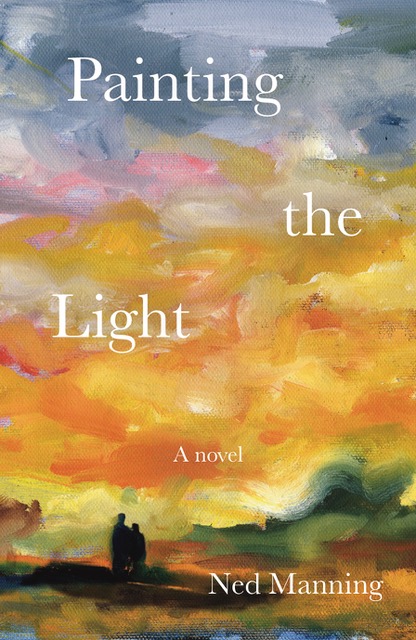
The first Act of Painting the Light’s life was the writing. It was variously intimidating, challenging and confronting. There were times when I asked myself: “Can I do this?” I’d never asked that question about anything else I’ve ever written. Maybe I should have. The thing is, I didn’t allow the question to hover. I dismissed it and got on with it.
It turned out to be the best writing experience of my life. I loved writing Painting the Light. I never had to force myself to sit down and write it. It was truly a labour of love. I love the characters and the way they took on a life of their own. There were “scenes” (I’m a playwright, I can’t help it … ) that would take off in directions I had never imagined. I knew the basic plot, spent years working it out, but I was constantly surprised by things that just seemed to pop onto the page by themselves. All I was doing was the typing.
Act 2 has been quite another matter. Getting the book out there is also intimidating, challenging and confronting. It also requires enormous patience and persistence. I won’t pretend that I love every minute of it. In the world of books, I’m a nobody. My publisher (Broadcast Books) is a small, indie outfit. They have been incredibly supportive. But, I have discovered just what a competitive world this is. There are literally hundreds of books published in any given week. So, getting traction is very difficult. I’ve had to call on long suffering friends to ask for it in bookshops, to post reviews, to tell their friends. I’m sure some of them get heartily sick of me. But … what can a poor boy do? One thing I do know is, if I take the foot off the pedal, nothing will happen.
For a playwright, writing his first novel, it has been an incredible learning curve. If you’re lucky enough to have a play produced, you go to rehearsals and opening night. You pray you get good reviews, you enjoy the season and then it’s over. Six weeks. It may get another guernsey, it may get published, it may become a hit. But it’s all over relatively quickly.
Put it this way. When (or if) someone buys your novel, it might sit on their bedside table for six weeks. It might get forgotten amongst the prize winners and famous authors’ releases. It might never see the light of day in many bookshops. What I’ve learnt is, you have to be relentless. You have to keep going, trying to get people to (at least) buy it. You become, in fact, your own bookseller. Some aspects of it I quite like. Taking copies out to the Booktopia Warehouse, for instance. I love that. When bookshops take it on, it’s a buzz. When they look down their noses at you, it’s a bit dispiriting. But, as I’m learning, it’s all part of the gig. It’s a long, long haul. You get the odd break, someone interviews you and there’s a spike of interest. Maybe. Maybe not.
Fortunately, I love Painting the Light and I’ll never tire talking about it and sharing it with readers. I hope you enjoy it too.